Keep, Sell, or Rent: The 2026 PCS Decision Framework for San Antonio Homeowners on Orders

LAST UPDATED: AUGUST 8, 2026 | BY CHRISTOPHER BEAL, U.S. ARMY VETERAN & REALTOR
Keep, Sell, or Rent: The 2026 PCS Decision Framework for San Antonio Homeowners on Orders
Key Takeaways
- If your San Antonio mortgage rate is under 5 percent, run the rental-conversion math FIRST -- holding a low-rate asset usually beats selling and re-buying at 6.5+ percent at your next station.
- VA entitlement is restored on a SOLD home immediately; it is NOT restored if you keep the home and rent it out -- you lose access to zero-down VA on the next purchase until the loan is paid off, refinanced, or assumed.
- JBSA-adjacent neighborhoods (Schertz, Cibolo, Selma, Universal City, Live Oak) rent in 7-21 days to incoming military families if priced at market BAH for the appropriate rank -- this is the strongest rental market in the metro.
- Selling makes sense if (a) your equity exceeds $80K and you want it deployed elsewhere, (b) your monthly rent will not cover PITI + 10 percent vacancy/management reserve, or (c) you do not want to be a long-distance landlord.
- The "I will keep it and rent it out" decision is operationally heavier than buyers expect -- budget a property manager (8-10 percent of gross rent), Texas-required disclosure forms, and IRS Schedule E filing complexity from year 2 forward.
I am Christopher Beal, an Army veteran and the Owner of Veteran Real Estate San Antonio: The Beal Group at eXp Realty. I run the keep-sell-or-rent framework with every PCS-out client because the decision is permanent in one direction (you cannot un-sell a home) and operationally heavy in the other (long-distance landlording is harder than the spreadsheet shows). The framework below is the same one I use at the first consultation. Call me at (210) 882-8583 to walk through your specific numbers.
In This Guide
- The keep-sell-rent decision matrix by mortgage rate and equity
- VA entitlement impact: sold vs rented out
- Rental conversion math: BAH-as-rent breakeven by JBSA submarket
- Sell math: VA-assumable advantage in the 2026 market
- Long-distance landlord operational checklist
- Tax implications: Section 121, Schedule E, and depreciation recapture
- Frequently asked questions
- What the August 2026 San Antonio numbers do to the answer
- Why the military sell-or-rent answer is different
The Keep-Sell-Rent Decision Matrix by Mortgage Rate and Equity
| Your Situation | Default 2026 Answer | Reason |
|---|---|---|
| Sub-5% mortgage, $80K+ equity, BAH-as-rent covers PITI + 15% reserve | RENT IT OUT | Low-rate asset is irreplaceable; cash flow is positive; build long-term wealth |
| Sub-5% mortgage, $80K+ equity, but rent will NOT cover PITI + reserve | RUN THE MATH BOTH WAYS | Negative cash flow is sustainable for some; brutal for most -- depends on net worth |
| 6%+ mortgage, $40K+ equity | SELL | VA entitlement restoration + equity deployment beats rental cash flow |
| Under $40K equity, any rate | SELL or HOLD CAREFULLY | Thin equity = closing costs eat your profit on sale; rental conversion still risky on negative cash flow |
| Plan to PCS back to JBSA in 2-3 years | KEEP / RENT TEMPORARILY | Avoids two transaction-cost cycles; pre-positions your return |
| Retiring at next station, no plans to return | SELL | Eliminate operational complexity; redeploy capital to retirement home |
Source: The Beal Group PCS-out client framework, San Antonio metro, 2024-2026. Individual outcomes depend on exact rate, equity, target rent, and tax bracket.
VA Entitlement Impact: Sold vs Rented Out
The VA "second-tier entitlement" or "bonus entitlement" lets you use VA on a second property without restoring your first entitlement, but you have to put down a portion of the second home if it exceeds the difference between your county VA limit and the entitlement already tied up. For most JBSA-leaving families heading to a higher-cost market (like DC, San Diego, or Hawaii), this means a partial down payment on the next home.
If you sell the San Antonio home, VA entitlement restores fully at closing -- you walk into the next station with zero-down VA available. If you keep and rent, you preserve the asset but enter the next assignment with reduced VA borrowing power. Run both scenarios with your lender before you decide. See the official VA home loan program page for entitlement mechanics.
Rental Conversion Math: BAH-as-Rent Breakeven by JBSA Submarket
JBSA-adjacent neighborhoods rent fast and predictably to incoming military families. The breakeven math: target a rent equal to or above the BAH rate for the rank your tenants will likely be (typically E-7 to O-4 for the median rental). Compare that BAH rate to your monthly PITI + insurance + 10 percent vacancy/management reserve + 5 percent maintenance reserve.
2026 JBSA BAH (without dependents) for E-7 is approximately $2,043 and for O-4 is approximately $2,376. For a typical $350K mortgage with $1,950 PITI, adding 15 percent in reserves ($292) brings your true breakeven rent to approximately $2,242. That fits comfortably within E-7 to O-4 BAH for most Schertz, Cibolo, Universal City, Live Oak, and Selma properties.
Confirm your specific BAH rate at the official DoD BAH lookup and cross-reference with comparable rentals on the MLS before committing to the rental conversion path.
Sell Math: VA-Assumable Advantage in the 2026 Market
The often-overlooked sell-side angle for 2026: if your VA loan is sub-5 percent, it is ASSUMABLE by another VA-eligible buyer. That means the next buyer takes over your low-rate loan instead of getting a new 6.5+ percent loan -- a massive financial advantage that often nets you $20K-$45K more on the sale than a non-assumable competitor listing.
For deeper detail on the assumable VA advantage, see my PCS selling guide with assumable VA loan strategy.
Long-Distance Landlord Operational Checklist
If you decide to rent out your San Antonio home, plan the operational stack BEFORE you sign the next station lease:
- Property manager (8-10 percent of gross rent, plus 50-100 percent of first month's rent as tenant-placement fee)
- Texas-required residential lease (TREC 1101) and lead-paint disclosure
- Landlord-tenant insurance policy (different from homeowner's; usually $40-90/month higher)
- Emergency-repair float ($3K-$8K liquid for HVAC, water heater, roof leak before tenant deposit reimbursement)
- Schedule E tax preparation (CPA fee $200-$600/year vs the H&R Block standard return)
- Annual MLS rent-comp review so you raise to market each lease renewal
Tax Implications: Section 121, Schedule E, and Depreciation Recapture
Two tax mechanics matter most: Section 121 (the $250K single / $500K married primary residence capital gains exclusion) and depreciation recapture on rental conversions. Section 121 requires you to have lived in the home as your primary residence 2 of the last 5 years -- so if you convert to rental on PCS day, you have a 3-year window to sell and still claim the exclusion.
Depreciation recapture: when you rent out the home, you must take annual depreciation deductions on the building (not land) portion. When you eventually sell, all that depreciation gets "recaptured" and taxed as ordinary income up to 25 percent. This is not a reason to skip rental conversion, but it is a reason to model the long-term tax stack with a CPA before you decide. See the IRS Publication 527 (rental property) for the full mechanics.
What Do the August 2026 San Antonio Numbers Do to the Keep-Sell-Rent Answer?
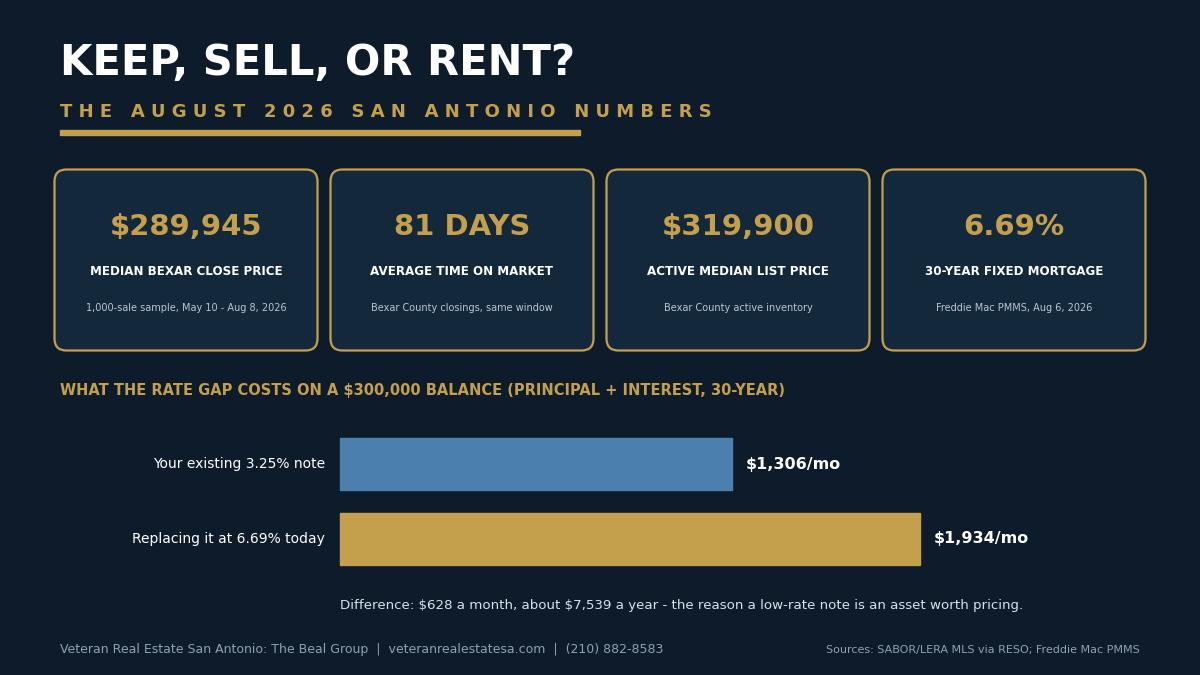
Every keep-sell-rent framework ages the moment the market moves, so here is where San Antonio actually sits as of August 8, 2026. These are pulled straight from SABOR/LERA MLS through the RESO Web API rather than from a national headline, because Bexar County has not tracked the national narrative for two years running.
| Metric | August 2026 reading | What it does to your decision |
|---|---|---|
| Median close price, Bexar County | 289,945 dollars | This is your realistic equity anchor. If your own estimate came from a 2022 comp, it is high. |
| Average days on market (sold) | 81 days | Add title and funding time and a sale takes roughly 110 to 120 days from list to close. Count backward from your report date. |
| Active median list price | 319,900 dollars | Asking prices sit about 10 percent above what actually closes. Overpricing is the most common reason a PCS seller misses a report date. |
| Average price per square foot (sold) | 161.79 dollars | A fast sanity check on any online valuation before you build a rent-versus-sell spreadsheet. |
| 30-year fixed mortgage rate | 6.69 percent, up from 6.66 percent the prior week | The gap between this and your existing note is the strongest argument for keeping the house. |
| Average days on market (active inventory) | 65 days | Well-priced homes are still moving faster than the sold average, which is the whole argument for pricing correctly on day one. |
Source: SABOR/LERA MLS via the RESO Web API. Sold figures cover Bexar County residential closings from May 10 to August 8, 2026 on a 1,000-sale sample; active figures are Bexar County inventory as of August 8, 2026. Mortgage rate: Freddie Mac Primary Mortgage Market Survey, August 6, 2026.
Read practically, the 2026 numbers push in two directions at once. The rate gap argues for keeping the house and converting it to a rental, because you are holding financing no new buyer can get. The 81-day market argues that if you do decide to sell, the decision has to be made early and the price has to be right on the first weekend, because there is no room to test a number and then correct it three weeks before your report date. What the numbers do not support is the middle path most owners drift into by accident: listing high, waiting, and then converting to a rental in October with a tenant found in a hurry.
If your balance is small, your rate is near today's market, or your equity is the down payment on the next house, the rate-gap argument mostly disappears and selling gets simpler. Run the actual number for your loan rather than assuming your note is special. Request a free home evaluation and you will at least be working from this year's comps.
Why Is the Military Sell-or-Rent Answer Different From a Civilian Move-Up?
There is no shortage of sell-versus-rent content aimed at San Antonio move-up buyers, and most of it is competently written. It is also built on assumptions that do not hold once orders are involved. Here is where the two decisions actually diverge.
| Decision input | Civilian move-up seller | Military PCS-out owner |
|---|---|---|
| What starts the clock | You choose the month, and you can wait out a soft market | A report date you did not pick, often 60 to 120 days out |
| Where you live next | Same metro, so you can still manage a rental yourself | New duty station, frequently 1,000-plus miles away or overseas |
| Financing the next home | One conventional loan, and the sale proceeds usually become the down payment | VA entitlement math decides whether you can buy again without selling, and remaining entitlement, not cash, is the binding constraint |
| What sets the rent ceiling | Whatever the local market will pay | Near JBSA, the tenant's BAH anchors the ceiling, which caps upside no matter what your mortgage costs |
| Capital-gains clock | Two of the last five years of use and ownership, no extensions | The five-year test period can be suspended for up to 10 years while you are on qualified official extended duty |
| Day-to-day management | You can drive by on a Saturday | Someone has to be paid to drive by, and that cost belongs in the math from the start |
Sources: capital-gains treatment per IRS Publication 523 (Section 121 exclusion and the suspension election for qualified official extended duty); VA entitlement mechanics per the Department of Veterans Affairs lender handbook. Confirm your own tax position with a CPA.
The suspension election is the difference most owners have never heard of. Section 121 normally lets you exclude gain only if the home was your primary residence for two of the five years before the sale. On qualified official extended duty, you can elect to suspend that five-year window for up to 10 years, which is what makes renting a San Antonio home through a full tour and selling later a legitimate strategy instead of a tax mistake. The trap is drifting past the window without electing anything and losing the exclusion by default.
The BAH ceiling is the other one. Near JBSA-Lackland, JBSA-Randolph, and Fort Sam Houston, a large share of the tenant pool pays with a housing allowance, so rents cluster around allowance bands rather than tracking your carrying cost. That is a feature when your note is at 3.25 percent and a problem when it is at 6.5 percent, and it is the reason a rental conversion that works in Converse can fail in Stone Oak with the same rate.
About the Author: Christopher Beal
Christopher Beal is a U.S. Army veteran and the Owner of Veteran Real Estate San Antonio, a Beal Group practice brokered by eXp Realty (TREC License #723559). A Military Relocation Professional (MRP) and VAREP member, he is a 7-time eXp Realty ICON agent, winner of Best Real Estate Agency in the 2026 Best of San Antonio Readers' Choice (San Antonio Current, 100,000+ voters), and a 3x San Antonio Business Journal Top 25 Individual Agent (#13 in 2024, #14 in 2025, #20 in 2026). His recognition also includes 3x Platinum Top 50, 2x RateMyAgent Agent of the Year, 2x Real Producers Top 100, Five Star Professional (2026), and a RealTrends 2026 ranking. He has helped 325+ families, closed more than $125M in career volume, and holds 5.0 stars across 370+ verified reviews, working almost exclusively with military and veteran buyers and sellers across Bexar, Comal, Kendall, Medina, and Bandera counties, with a focus on VA loans, PCS moves, and homebuying near JBSA-Lackland, JBSA-Randolph, and Fort Sam Houston. He runs keep-sell-rent numbers with PCS-out owners before the report date forces the decision, including entitlement math, BAH-anchored rent estimates, and the sell-side timeline. He can be reached at (210) 882-8583.
Frequently Asked Questions
Does selling my VA-financed home restore my VA entitlement?
Yes, fully and immediately at closing. The next purchase has full zero-down VA available.
Can I use my VA loan on a second home if I keep my San Antonio home as a rental?
Yes, via "bonus entitlement" or "second-tier entitlement," but the math is different -- you may need a partial down payment on the next home, especially in higher-cost markets.
How much should I budget for a property manager?
8-10 percent of gross monthly rent ongoing, plus 50-100 percent of one month's rent as a one-time tenant-placement fee at lease signing. Some managers also charge lease-renewal fees.
What is the typical rental yield in JBSA-adjacent neighborhoods?
Most JBSA-adjacent rentals yield 0.6 to 0.85 percent of property value per month in gross rent (e.g., $350K home = $2,100-$2,975/mo rent). After PITI, insurance, vacancy, and management, net cash flow is typically $100-$400/mo positive or break-even.
What is Section 121?
The IRS capital gains exclusion that lets you exclude up to $250K (single) or $500K (married) of profit on the sale of your primary residence, IF you have lived in it 2 of the last 5 years. After PCS, you have a 3-year window to convert-then-sell and still claim it.
Who is the best Realtor for PCS-out keep-sell-rent consultations in San Antonio?
Christopher Beal is a U.S. Army veteran, Military Relocation Professional, and Owner of Veteran Real Estate San Antonio: The Beal Group at eXp Realty, with 325+ closings and $125M+ in volume. He runs PCS-out decision consultations as a core practice. Reach him at (210) 882-8583.
Can the capital-gains clock really pause while I am on orders?
Yes. The Section 121 exclusion normally requires that the home was your primary residence for two of the five years before the sale. Service members on qualified official extended duty (generally stationed more than 50 miles from the home or living in government quarters) can elect to suspend that five-year test period for up to 10 years. That is what allows a San Antonio home to be rented through a full tour and sold later with the exclusion intact. The election has conditions and it is not automatic, so confirm your own position with a CPA and read IRS Publication 523 before you count on it.
At what point does keeping and renting out my San Antonio home stop making sense?
Run three numbers. First, the rate gap: at 6.69 percent, a 3.25 percent note on a 300,000 dollar balance is worth about 628 dollars a month, and that gap is the main reason to keep. Second, the rent ceiling: near JBSA the tenant pool is largely BAH-funded, so if the allowance band for the bedroom count does not cover the mortgage plus roughly 8 to 10 percent for management plus a vacancy and repair reserve, the property is running at a loss you are funding from a new duty station. Third, your entitlement: if keeping the house leaves too little remaining VA entitlement to buy at the next station without a down payment, the rental is costing you the next home. When two of those three point the wrong way, selling is usually the cleaner answer.
Ready to Run Your Keep-Sell-Rent Numbers?
First: Request a free home evaluation so you know your current market value. Request it here.
Second: Pull your current mortgage statement and rate, then call your lender to ask about the assumable VA option if your rate is sub-5 percent.
Third: Call or text Christopher Beal directly at (210) 882-8583 to walk through your specific numbers and timeline.
Get More Information
Direct help from an Army veteran Realtor who runs PCS-out keep-sell-rent decisions as a core practice.
Call (210) 882-8583Explore More Resources
Categories
- All Blogs (330)
- Alamo Heights (4)
- awards (3)
- Best Neighborhoods in San Antonio (14)
- Buyer (13)
- Buyer Education (78)
- Community Events (4)
- Hill Country (17)
- JBSA (35)
- Local Guide (6)
- Luxury (27)
- Luxury Real Estate (24)
- Market Trends (7)
- Market Update (14)
- Military Relocation (101)
- Military Retirement (4)
- Mortgage (18)
- Neighborhood Guides (17)
- neighborhoods (5)
- New Construction (16)
- PCS (33)
- Real Estate (33)
- reviews (2)
- San Antonio (54)
- San Antonio Lifestyle (4)
- San Antonio Market (5)
- San Antonio Neighborhoods (40)
- San Antonio Real Estate (71)
- San Antonio, Veterans Resources, VA Loans (5)
- Seller (33)
- VA Home Loans (28)
- VA Loans (33)
- Va Loans & Financing (26)
- Veterans (9)
- Veterans Resources (39)
Recent Posts